

RFD4-Proteina#
A next generation sequence structure codesign model for proteins, RNA, DNA and small molecule complexes.
Capable of satisfying robust conditioning and generating plausible sequences without further refinement.
Developed by the Baker Lab × NVIDIA GenAIR, with the Institute for Protein Design at the University of Washington.
We gratefully acknowledge the Jen-Hsun and Lori Huang Foundation for providing a computational grant used for this study.






Installation
Set up the environment, checkpoints, and cluster config.
Examples
Runnable notebooks that take one design problem end to end.
Input Preparation
Build and validate an annotated CIF from your design intent.
How-to guides
Task-oriented instructions: the config overrides and CLI flags
for a specific job.
Concepts
How the pieces fit together: annotated CIFs, generation modes,
search, and metric guidance.
Reference docs
Lookup tables and syntax for configs and CLI options.
Contributing
How to propose changes, code style, and review expectations.
What you can design#
The released checkpoint supports all of these design tasks.
Task |
Status |
|---|---|
Unconditional generation |
Supported |
Motif scaffolding |
Supported |
Enzyme design |
Supported, with a worked example |
Small molecule binder design |
Supported |
Protein binder design |
Supported |
DNA binder design |
Supported |
State-of-the-art performance across relevant biomolecular tasks#
Average per-target success rate, unclustered
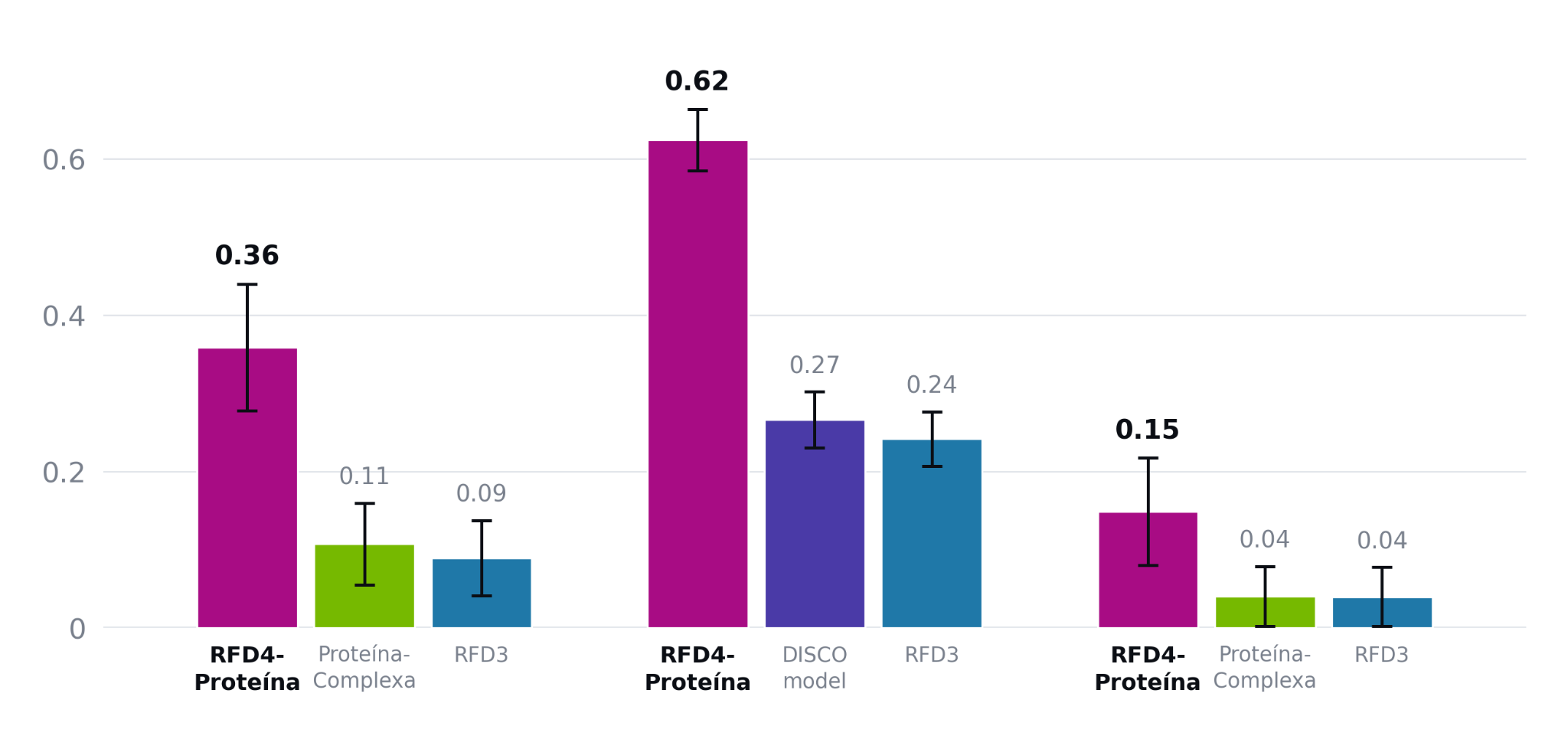
Enzyme design
Small molecule binders
Protein binder design