

Thirty-two numbers, six molecular contexts#
Move one latent channel. Watch a protein, DNA, RNA, a phosphorylated residue, a noncanonical amino acid and a glycan respond together.
Pick a column, shift it, walk along it, or add noise. All six views show actual decodes from the release autoencoder, with anchors and native identity conditions fixed.
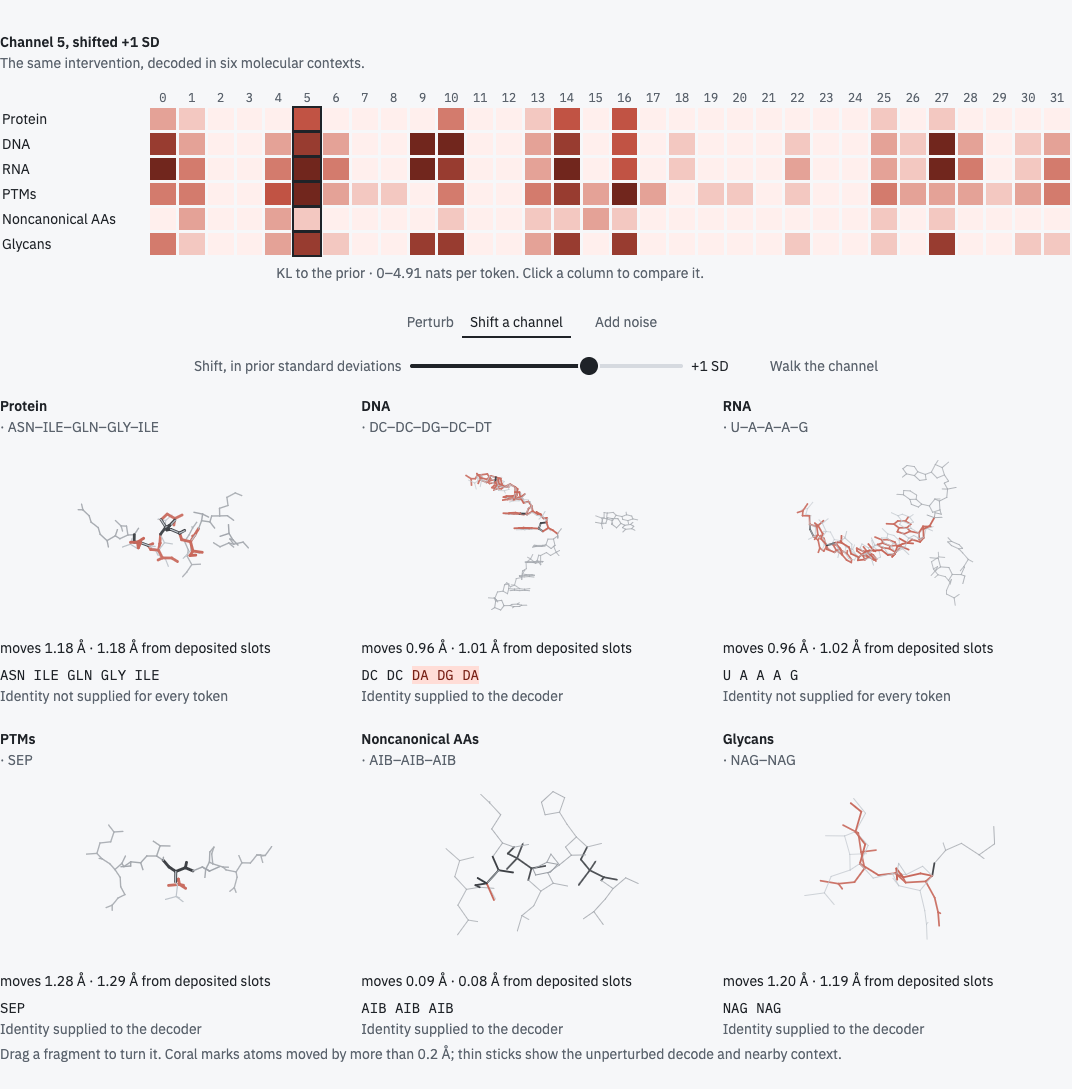
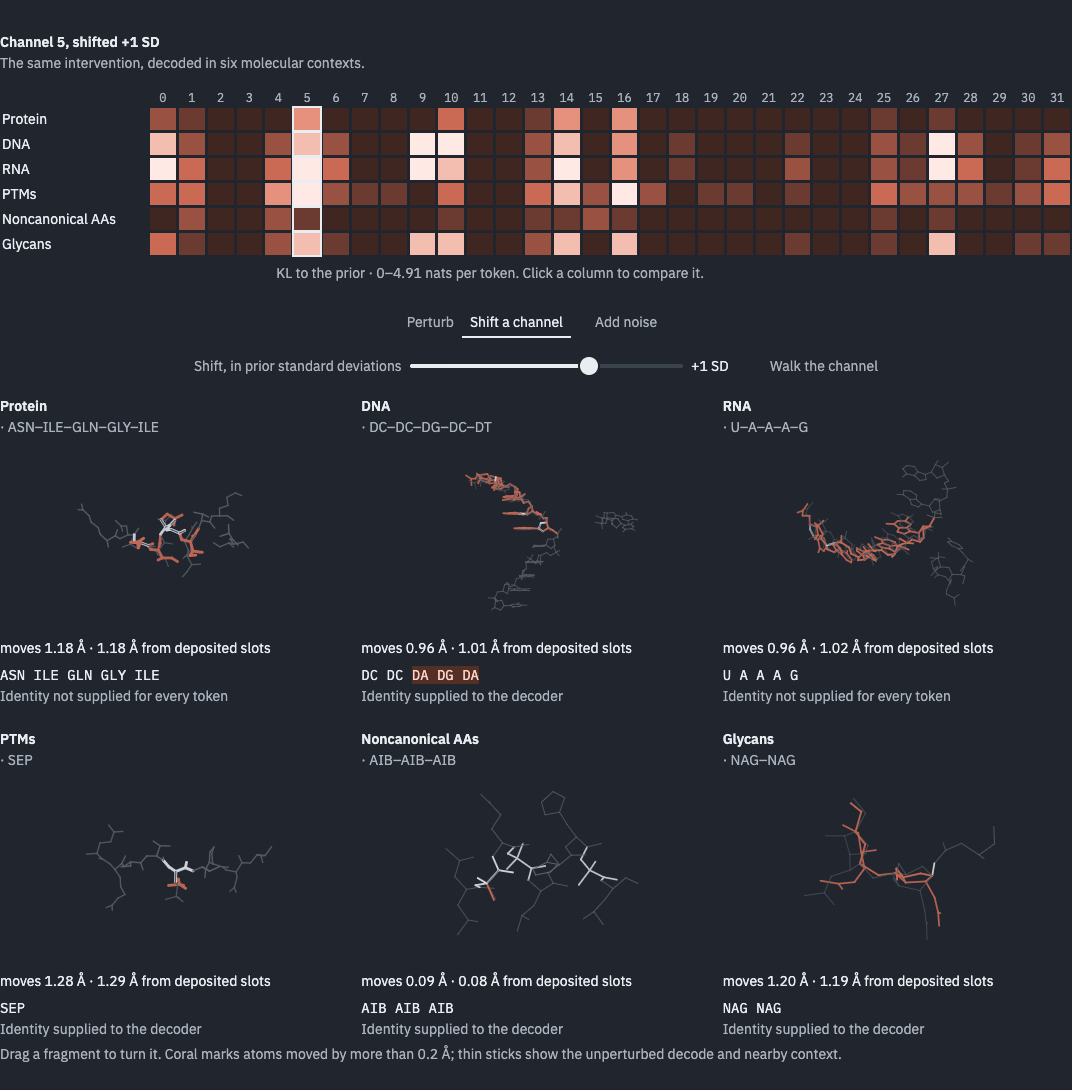
Top: protein, DNA, RNA. Bottom: phosphorylation (phosphoserine, SEP), noncanonical amino acids (AIB), glycans. Up to five nearby tokens per view; the full input remains decoder context. Sticks follow deposited atom slots, not validated new chemical topology.
Where do the nats go?#
Half the protein KL rate sits in just three of 32 channels. The phosphorylation subset needs eight. Switch to decoder sensitivity to see whether a high-rate channel also moves atoms when removed. Noise tolerance shows how reconstruction changes under three actual noise draws on all 32 channels.
A nat is a log-probability unit. Here the rate is KL from the posterior to the
unit-normal prior; it includes prior mismatch and is not mutual information.
“Active” means the posterior mean varies across tokens: Var(μ) > 0.01.
Rate, activity and decoder sensitivity answer different questions.
Fixing a Broken ELBO motivates
reading compression together with reconstruction. Our noise sweep holds the
checkpoint fixed; it is not an optimized rate–distortion frontier.
Identity is also an input#
Removing supplied identity changes recovery from 100% to 0% in both small phosphorylation and AIB/norleucine subsets. Glycans fall to 68.6%. The latent is only one input to the decoder; native identity recovery alone cannot establish what it encodes.
The glycan average hides a large imbalance: 160 of 229 tokens are NAG. Always choosing NAG would score 69.9%; averaging the cleared-identity accuracy equally across the eight identities gives 14.0%. DNA and RNA both retain 99.8% under that same equal-identity average. This probes dependence on supplied identity, not whether the latent contains no identity information or whether sequence is generated before structure. Per-identity counts and the reproducible audit.
The PTM statistics cover 38 SEP/TPO tokens; noncanonical statistics cover 39 AIB/NLE tokens. These are explicit subsets of the measured cohort, not a complete classification of modified amino acids. The views use one representative input each, selected by identity and input order, never by reconstruction quality.
Picked channel: exact rates, activity and ablation
Channel 5. Rates and activity use each panel's measured subset; ablation measures movement in its representative input.
| Context | KL nats/token | Variance of μ | Active | Ablation, Å |
|---|
Checkpoint, measurements and limitations
The latent has 32 channels per emitted residue. Both encoder and decoder have 12 transformer layers of width 768 with 12 attention heads, query/key normalization, and no attention pair bias, pair updates, or triangle multiplication. The encoder reads atom coordinates, element/charge and incident-bond features. The decoder reads the latent, anchor coordinates, token type, and supplied sequence conditions.
The 147-entry vocabulary contains 100 modified/noncanonical amino acids and 13 glycans, alongside standard amino acids and nucleotides and special entries. Atomized components retain explicit identities; they are excluded from this residue-latent analysis. Vocabulary size is not evidence that every entry is well reconstructed or independently generatable.
We sampled 128 inputs from each of five committed temporal-holdout panels with seed 20261011, using the validation pipeline. All 640 completed. Examples can contain several chemistries. Counts below include only resolved, AE-emitted tokens, so neither padded slots nor atomized context contributes.
Chemistry |
Tokens |
Observed identities |
KL nats/token |
Active channels / 32 |
|---|---|---|---|---|
Standard amino acids |
154,844 |
20 |
18.76 |
21 |
Modified/noncanonical amino acids |
198 |
25 |
40.75 |
32 |
Glycans |
229 |
8 |
33.93 |
17 |
DNA |
6,108 |
4 |
47.05 |
23 |
RNA |
4,541 |
4 |
50.23 |
24 |
For diagonal posterior q = Normal(mu, exp(log_scale)), each channel’s KL to the
unit-normal prior is 0.5 * (mu² + exp(2*log_scale) - 1 - 2*log_scale). Rates in
the table weight tokens equally. They include prior mismatch and are not mutual
information estimates. Different atom counts, chemistry distributions, and
poses can contribute to rate differences.
An active unit has population variance of its posterior mean greater than 0.01. This definition follows the diagnostic used by Burda et al., rather than interpreting every nonzero KL as information used by the decoder. Activity is coordinate-dependent and threshold-sensitive: at 0.1 the respective counts are 13, 29, 16, 18, and 18. The JSON also provides the 0.001 threshold and example-weighted rates with example-bootstrap intervals. Overlapping PDB-derived inputs are not independent structures; these intervals are exploratory, not a held-out performance claim.
The six-context plots partition out phosphorylation (SEP/TPO/PTR; PTR is absent in this cohort) and AIB/NLE from the original pooled modified-AA group above. Other modifications remain in that pooled summary but are not assigned to these two illustrative subsets.
Shifts span −3 to +3 prior standard deviations in steps of 0.5. Noise uses four scales and three seeded draws, with a fixed direction across scales. Each state is independently decoded; no coordinate interpolation is presented as inference. Display offsets are quantized to 0.01 Å. Native conditions and anchors are fixed. Ablation zeros one channel across all matching tokens in one representative input; its atom-slot displacement is not a chemical-validity or population-wide score. The downloadable summary also retains the joint PCA (23.6% variance explained), which is confounded by pose and chemistry imbalance.
The measurements use the release autoencoder rfd4-proteina-ae-release-2026-10-19 (global step
400,000, strict load of the EMA weights), the model source at f5db9617fa98f377cae5984a98187489ea3997a4
and AtomWorks 3.0.4.
Latent decoding here keeps the input’s anchors and conditions; it is not de novo sampling from the joint flow prior.
Activity follows Burda et al.. For interpreting unused latents, see posterior-collapse diagnostics.